In a bottle
A flat-packed ship, a pulled thread, and a method shrouded in secrecy.
Royal Museums Greenwich describes the typical nineteenth-century technique, and says Shonibare’s own method is a secret.
A ship in a bottle looks like a puzzle that has already been solved. Royal Museums Greenwich tells both a typical historical method, and a contemporary work whose own method it will not describe.
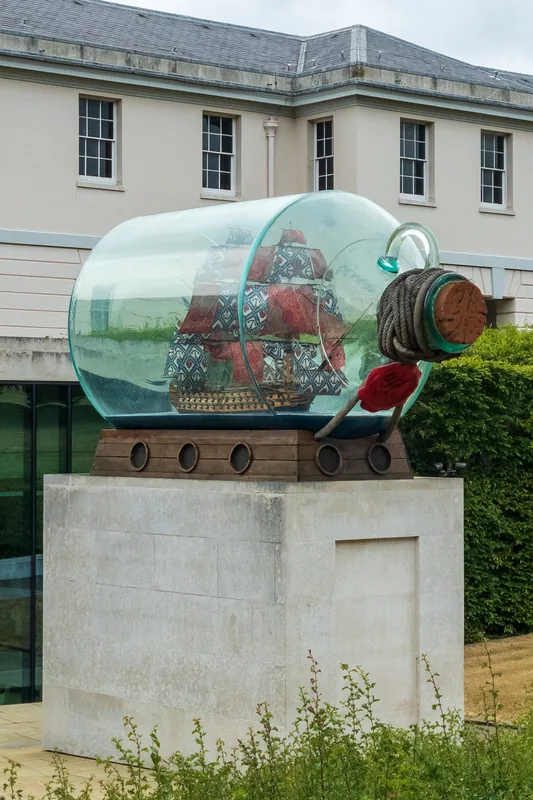
The museum’s attraction page calls Nelson’s Ship in a Bottle “a scaled-down replica of HMS Victory,” Vice-Admiral Horatio Nelson’s flagship at the Battle of Trafalgar in 1805, made by Yinka Shonibare CBE. The piece was created for Trafalgar Square’s Fourth Plinth project and unveiled in the Square in 2010. Since 2012 it has stood outside the National Maritime Museum’s Sammy Ofer Wing, after a fundraising campaign with the Art Fund. [source]
The museum’s object record is more precise about the scale and the fit-out: it is “a 1:30 replica of Nelson’s flagship, HMS ‘Victory’,” and “has 80 guns and 37 sails set as on the day of battle.” [source] The attraction page describes the sails as 37 patterned sails that “reference Indonesian batik designs (the art of decorating cloth using wax and dye), which were mass-produced by Dutch traders and sold in West Africa.” [source] The object record says the richly patterned sails “were inspired by Indonesian batik, mass-produced by Dutch traders and sold in West Africa.” Both official wordings are kept.
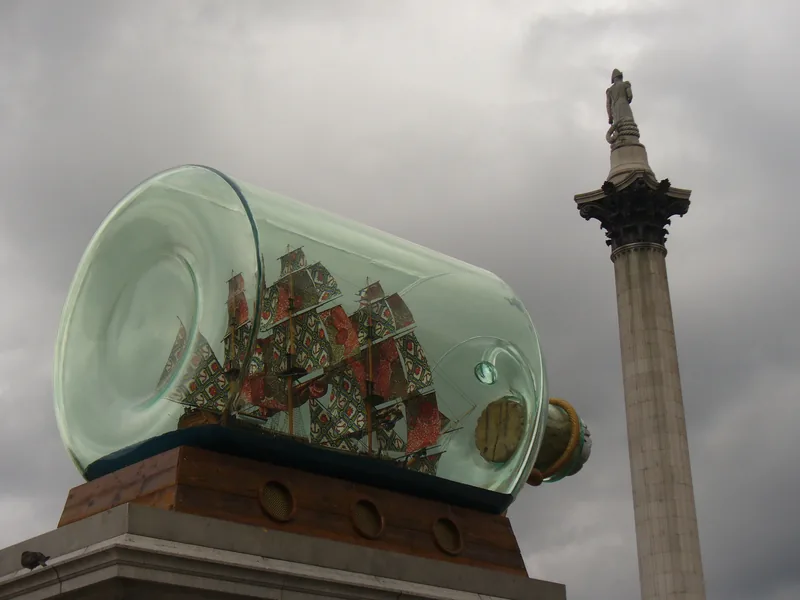
The attraction page also says the work “draws inspiration from the craft of putting ship models inside glass bottles, which grew in popularity during the 19th century.” Then comes the method, carefully split: “While Shonibare’s method is shrouded in secrecy, the technique typically involves tying cotton threads to the masts of a ‘flat-packed’ ship. Once the ship is laid inside the bottle, the strings are pulled to raise the masts.” [source]
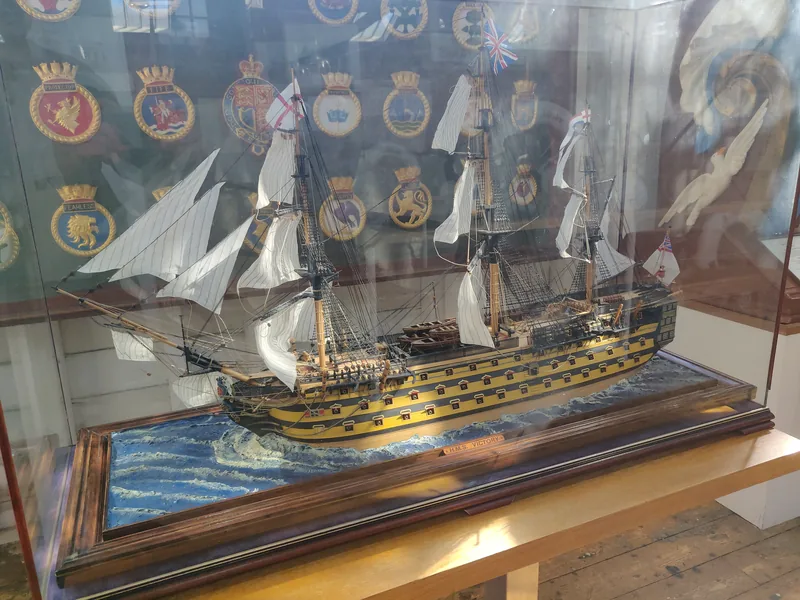
For Shonibare, the museum says, the work is a celebration of multiculturalism. “The 823 men on board the Victory at the Battle of Trafalgar came from a range of nations and regions including Brazil, India, Africa and the Caribbean.” Shonibare, quoted on the same page, calls it “a celebration of London’s immense ethnic wealth, giving expression to and honouring the many cultures and ethnicities that are still breathing precious wind into the sails of the United Kingdom.” [source]
A separate Royal Museums Greenwich how-to page for making a ship in a bottle could not be opened successfully when this desk was checked (the request returned an error). This site does not reconstruct that craft article from search snippets. The typical method quoted above is the one on the attraction page that did open.
Enjoyed a desk of official kit histories, unblended firsts, and a practical workbench?
No pop-ups. No intrusive advertising. Just interesting stuff. A little support helps the next ReallyByte site get built.